
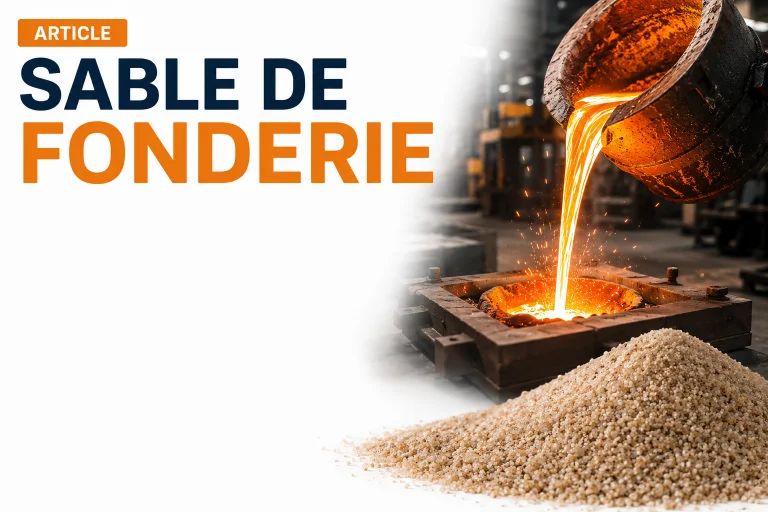
What is silica foundry sand?
Siliceous foundry sand is a moulding sand industrial, consisting mainly of quartz grains (SiO₂). To be classified as suitable for foundry use, this product must have a minimum silicon dioxide content of 98 %.
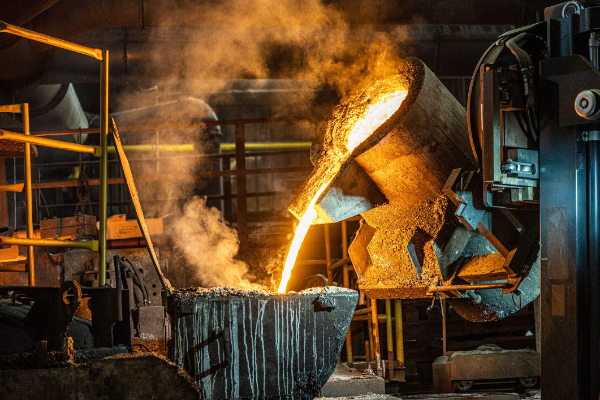
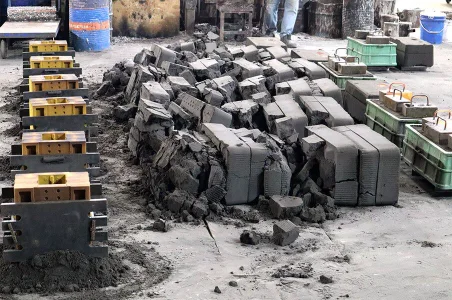
This sand is used in the manufacture of moulds capable of containing ferrous and non-ferrous metals at very high temperatures. Of the various types of sand available, silica is the most widely used — and the most economical — choice worldwide.
Composition: silica, binder and water
Siliceous foundry sand is made up of three essential components. Each plays a specific role in ensuring the mould’s integrity when faced with molten metal.
Here is the typical composition of a sand-to-turf mix:
- Silica (SiO₂) : 85 to 95 % of the mixture — it forms the refractory skeleton of the grains of sand and withstands temperatures of up to 1,700 °C
- Bentonite : 5 to 10 % — this clay binder coats the grains of sand and ensures the mould holds together
- Water : 2 to 5 % — it activates the bentonite and gives the mixture its plasticity
- Additives : in small quantities — mineral black, dextrin or carbon improve refractoriness and surface finish
The rule to remember is that the mass of water should be about one-third of the mass of clay. Too much water weakens the mould; too little and it loses its cohesion.
Different types of foundry sand: green, oil-based and chemical
There are three main types of foundry sand, used according to production requirements. Firstly, the from sand to green — the most common method — combines silica, bentonite and water to form a mould without heat treatment. It is suitable for parts measuring between 10 and 800 mm and can be used for production runs ranging from single units to very large batches.
Next, oil-based sand (or petrobond) replaces the water with an oil-based binder. Its very fine particle size enables it to reproduce precise details. Please note: the casting process produces smoke and requires adequate ventilation.
Finally, the chemical-setting sand a mixture of silica and resins (1 to 2 % of the mixture) activated by a catalyst. This process produces very rigid moulds, capable of accommodating parts weighing up to 80 tonnes. Available ready for use, it is primarily intended for demanding small-batch production.
Technical specifications of our foundry sand
Grain size, density and thermal conductivity
The particle size distribution of silica sand is measured using the’AFS fineness index : the higher this index, the finer the grain. For castings, foundries aim for an index of between 55 and 65 AFS. Light alloys such as aluminium can tolerate higher indices.
The shape of the grains plays an equally crucial role. Rounded grains reduce binder consumption and improve permeability, whilst angular grains increase the mechanical strength of the mould.
Here are the three key physical properties to remember:
- Bulk density : approximately 1.52 kg/dm³ for dry silica sand
- Thermal conductivity : 0.25 W/(m·K) — sand conducts heat slowly, which slows down the cooling of the cast metal
- Specific heat capacity : 830 J/(kg·K), a parameter that directly influences the solidification rate of the components
Heat resistance and permeability
Pure silica reaches a vitrification temperature of 1,700 °C — a threshold that explains why this material dominates the global foundry industry. In practical terms, sand does not melt on contact with steel or molten cast iron, the casting temperatures of which rarely exceed 1,600 °C.
Permeability, for its part, directly determines the quality of the parts produced. During casting, gases form within the mould cavity. If they do not escape in time, they cause internal defects known as gas porosity — cavities that weaken the final component.
Firstly, a coarse grain promotes the release of gases, and thus permeability. Secondly, a fine grain improves the surface finish, but reduces that very same permeability. This is why the choice of grain size is always the result of a a trade-off between surface finish and mould ventilation :
- High AFS index : better surface finish, increased risk of premature vitrification and porosity
- Low AFS index : maximum permeability, rougher workpiece surface
Which metals can be cast using this sand?
Aluminium, bronze and brass
Require fine sand (70 to 90 AFS) to achieve a smooth finish and minimise the need for touch-ups.
Cast iron, steel and ferrous alloys
Require pure silica with a purity of over 98 % to withstand extreme temperatures (up to 1,550 °C). A coarser grain size is used (55 to 65 AFS) with a little charcoal to prevent the metal from sticking to the mould.
How much does foundry sand cost?
The price depends on the purity and preparation of the sand:
- In bulk (Industry): From €60 to €150 per tonne for raw silica. Allow for €2 to €5 per kg for ready-to-use technical sand.
- Small-scale operations (Artisans / Workshops):
- 1 kg: €8 to €12 (ideal for jewellery or test items).
- 5 kg: €20 to €30 (matte frame size).
- 25 kg: €45 to €60 (the standard economy fare).
To find out more and choose the right size for your moulds, take a look at the comprehensive guide on the Siliceous sand: particle sizes, properties and industrial applications .
Environmental impact and recycling of spent sand
Circular economy: When heated to a white-hot temperature, the sand eventually breaks down. Foundries clean it and reuse it up to 90 % in a closed loop. The rest is used in the construction industry (roads, cement).
Health: Take care with dry silica dust. Always wear a mask FFP3 when demoulding and mixing, to protect your lungs.
Need a siliceous sand high quality?
Contact our experts to receive a quote tailored to your business.
REQUEST YOUR PERSONALISED QUOTE →