
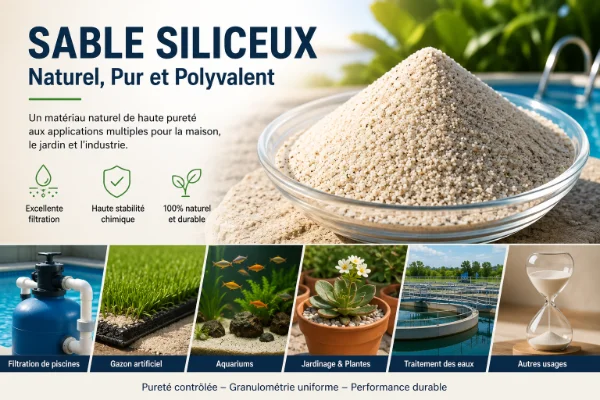
Silica sand accounts for nearly 70 % of the glass we use every day. From glassmaking to foundries, via filtration and construction, it is an essential raw material. The uses of silica sand vary by sector, with each requiring a specific level of purity and particle size distribution. This is why the choice of grade directly determines the final performance. This article reviews the various uses of silica sand, sector by sector.
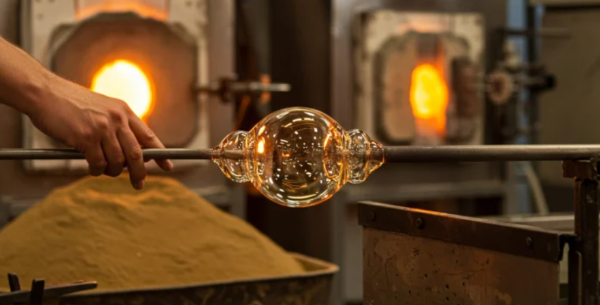
Siliceous sand: industrial and domestic uses
What is silica sand?
Siliceous sand is a industrial sand consisting mainly of silicon dioxide (SiO₂), extracted from deposits of natural silica sand. To be classified as ‘industrial-grade’, it must contain at least 95 % of SiO₂.
This material differs from ordinary sand in several remarkable physical properties:
- Hardness : 7 on the Mohs scale
- High melting point : heat resistance up to 1,550 °C
- Low coefficient of thermal expansion : dimensional stability under heat
- Chemical inertness : no reaction to acids or solvents
The grain size varies depending on the treatment applied after extraction. This is why each grade of sand is designed for a specific application. The content of iron oxide directly determines its colour and level of purity.
What is silica sand used for?
Glassworks, foundry and construction
Three sectors account for the bulk of global consumption of silica sand. Each imposes different purity thresholds:
- Glass manufacturing : SiO₂ > 99 %, particle size between 0 and 2 mm. Sand is the main raw material used in the manufacture of flat glass, hollow glass and optical fibres.
- Foundry : SiO₂ > 98 % for metals at high melting point just like steel. Sand is used to form the moulds into which molten ferrous and non-ferrous metals are poured.
- Building products : mortars, concrete and renders contain silica sand as mineral filler to enhance the structural strength of the structures.
The glass industry remains the world’s largest consumer, accounting for more than a third of total production. The foundry industry ranks second.
Water filtration and swimming pools
Washed silica sand 0.4/0.8 mm has established itself as the leading filter medium for swimming pools and wastewater treatment. Its particle size The calibrated filter retains particles down to 30–40 microns. It effectively traps organic matter, algae and suspended debris.
Its SiO₂ purity exceeds 96 %. This is why it withstands exposure to chlorinated products and fluctuations in pH without deteriorating. Lower-quality sand quickly compromises water clarity.
The areas of application are varied:
- Private swimming pools and water parks : comprehensive mechanical filtration, crystal-clear water all season long
- Wastewater treatment plants : removal of contaminants using filter columns
- Industrial drinking water : implementation in high-throughput multilayer filters
With a service life of 3 to 5 years, it is a reliable and cost-effective solution for the majority of installations.
Sandblasting, artificial turf and gardening
The quartz grains in silica sand effectively abrade metal, wood and plastic during abrasive blasting. Sand that has been washed, dried and dust-removed ensures consistent performance without damaging sensitive surfaces.
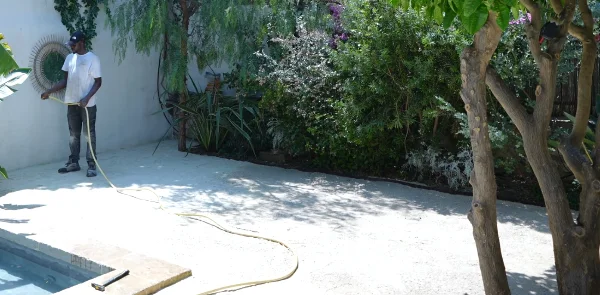
On the sports grounds As with padel courts or putting greens, silica sand is an important component of artificial turf. Distributed amongst the fibres, it keeps them upright, stabilises the surface and facilitates the drainage of rainwater.
The quantities vary depending on the height of the stalks:
- Short strands (12–30 mm) : 5 to 8 kg per m²
- Tall stalks (35–60 mm) : 8 to 20 kg per m²
The ideal particle size range is between 0.4 and 0.8 mm. In gardening, 0/4 mm silica sand loosens clay soils and improves root establishment in natural grass. For information on grain size, application rates per square metre and current prices, please see our guide to lawn sand.
How much does silica sand cost?
The price of silica sand depends above all on its purity and the extent to which it has been processed. Raw sand straight from the quarry does not exceed €25 per tonne on the global market. As soon as machinery is used to wash, sieve or grade the grain, the cost goes up.
Here are the ranges observed based on usage:
- Common particle sizes (construction and civil engineering works) : €20 to €50 (excl. VAT) per tonne in bulk
- High-purity foundry sand : €60 to €150 per tonne
- Advanced industrial applications (SiO₂ ≥ 98 %) : €60 to €120 per tonne, depending on the particle size
- 25 kg bag for domestic use : around €10
Do you need silica sand for your project?
Swimming pool filtration, aquariums, gardening, water treatment or industrial use: let us know your requirements and the quantity you need, and we’ll provide you with a tailored quote.
- Verified purity
- Fast delivery
- Personalised advice
Response within 24 working hours · no obligation
The quantity ordered has a direct impact on the unit price. Santa Cruz Silica offers annual contracts with sliding-scale rates for orders of 10,000 tonnes or more.