
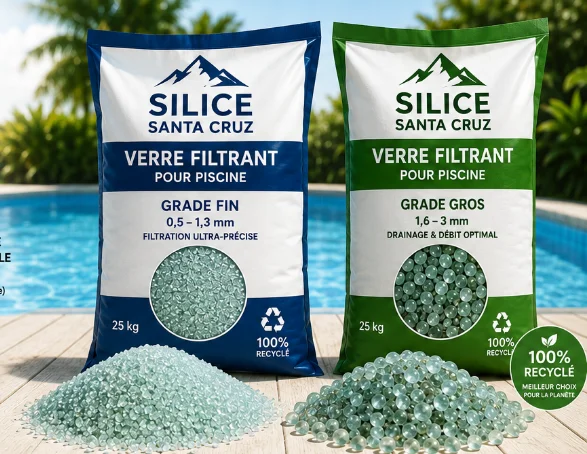
The glass sand is a filter medium made from recycled glass, designed to replace conventional sand in swimming pool sand filters. Its filtration fineness reaches 1 to 15 microns, compared with 40 to 55 microns for traditional sand. Non-porous and self-sterilising, it prevents the formation of biofilm and reduces the use of disinfectants. Its lifespan exceeds 8 to 10 years, which is twice that of sand. Choosing the right product and the correct particle size makes all the difference.
What is filter glass for swimming pools?
Composition and manufacture of filter glass
Filter glass is made from crushed, washed and polished recycled glass. Unlike the silica sand, its smooth, non-porous surface prevents organic residues from sticking to it.
The manufacturing process involves several specific stages:
- Sorting and shredding : selecting glass based on its purity
- Washing and drying : removal of any residual impurities
- Polishing and sizing : production of non-sharp pellets with a controlled particle size distribution
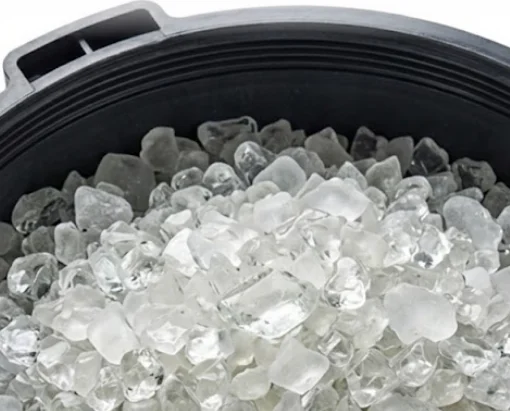
Some glass panes then undergo a chemical activation treatment — this is the principle behind the’AFM (Active Filter Media)). This process increases the negative surface charge and multiplies the total surface area of the material.
The result is that the glass filters out particles as small as 5 microns, compared with 50 microns for conventional sand. This significantly improves water quality.
Recycled glass: an eco-friendly filter medium
Recycling waste glass rather than extracting sand from the seabed: this is one of the most tangible environmental benefits of filter glass. Each bag of glass marbles diverts materials from landfill to give them a useful second life.
Its lifespan ranges from 7 to 15 years depending on the product, whereas sand needs to be replaced every 3 to 5 years. Fewer replacements mean less waste and less transport.
The environmental impact continues throughout the product’s lifetime. Thanks to its high permeability, backwashing becomes less frequent and shorter, which directly reduces water consumption. The depending on size The size of the granules plays a key role here: a well-calibrated grain size optimises water flow and minimises premature clogging, whilst also reducing the need for chemical disinfectants.
Filter glass vs sand: which is the better choice?
Sand traps particles from 30 to 40 microns in size. Filter glass, on the other hand, can trap particles as small as 15 microns — that is, a twice the filtration efficiency for significantly clearer water.
In terms of cost, glass is about twice as expensive to buy as silica sand. When viewed over its useful life, the difference narrows considerably, as the sand needs to be replaced much more frequently.
For a standard family swimming pool, high-quality sand remains a reliable and cost-effective solution. However, a swimming pool that is exposed to dust or pollen, or that is heated throughout the season gets real benefits from the filter glass: less clogging, fewer chemicals, and water that stays crystal-clear for longer.
What grain size should you choose for your sand filter?
Fine grade (0.5–1.3 mm): ultra-precise filtration
The final grade represents 70 % of the total load in a properly configured sand filter. It is this filter that does the real filtering work: trapping the microscopic particles that the coarse filter allows through.
With a particle size ranging from 0.5 to 1.3 mm, this media captures impurities down to 15 microns. When used in conjunction with a flocculant, this figure drops to as low as 5 microns — resulting in water that is almost crystal-clear.
Its carefully controlled particle size offers a twofold advantage: it maintains water flow without excessive pressure drop, whilst trapping fine particles such as pollen or suspended algae.
At Silices Santa Cruz, fine-grade filter glass is precisely calibrated to ensure consistent performance season after season, without settling or migration of the media towards the strainers.
Coarse grade (1.6–3 mm): flow rate and durability
Positioned at the bottom of the filter, the coarse grade forms the drainage layer essential for any properly sized system. Its particle size, ranging from 1.6 to 3 mm, allows water to flow freely without causing any pressure drop upstream of the strainers.
Its role is primarily mechanical: to absorb the strongest hydraulic flows and protect the strainers from becoming blocked prematurely by fine particles. Without this layer, the flow rate drops and the pressure in the tank rises dangerously.
The recommended proportion is 30 % of the total load in coarse grade, with the remainder made up of fine grade. At Silices Santa Cruz, this grade is produced to withstand repeated backwashing without breaking up or migrating into the fine filtration zones.
How much filter media is needed for a swimming pool filter?
The basic rule is simple: The filter media weighs about 15 % less than the sand. In practical terms, multiply the sand load specified by your filter’s manufacturer by 0,85 to work out how much glass you’ll need.
A telling example: does your filter recommend 100 kg of sand? Allow for 85 kg of filter glass — broken down according to the ratio of 70 % of fine grade and 30 % of coarse grade, as mentioned previously.
To help you find the right one quickly based on the diameter of your tank:
- 400 mm filter → approximately 35 kg of glass
- 500 mm filter → around 70 kg of glass
- 600 mm filter → around 100 kg of glass
- 750 mm filter → around 200 kg of glass
Never fill the tank more than two-thirds full, as this may block the water flow and overload the pump.
How do you fit the filter glass into your filter?
Steps for filling and protecting strainers
Before adding even a single grain of glass, Fill the tank to one-third of its capacity with clean water. This liquid cushion cushions the media as it falls and protects the strainers – those fragile screens at the bottom that trap the glass whilst allowing the filtered water to pass through.
Next, pour in the layer of highest grade first, directly onto the strainers, spreading it evenly by hand to avoid any clumps. The fine grade is added on top, gradually and without any sudden bursts.
On a top-mounted valve filter, block the central tube Before you begin: moving the tube whilst filling it will compromise the entire installation. Wear thick gloves — the edges of the glass, even if treated, are still slightly sharp. Never fill the tank more than two-thirds full.
Backwashing and commissioning
Once the filling is complete, The first backwash is compulsory before the filtration process begins. This step removes fine suspended glass particles and stabilises the media layers in the tank.
The procedure to follow is as follows:
- Turn off the pump, then set the multi-way valve to «Backwash»
- Restart the pump and let it run 3 to 5 minutes, until the water in the sight glass becomes clear
- Then switch to the «Rinse» setting for 1 minute to stabilise the filter bed
- Finally, switch back to «Filtration» mode and restart as normal
Check the pressure on the pressure gauge as soon as the system starts up: a needle in the green zone confirms that the system is operating correctly. With filter glass, this reference pressure remains stable for much longer than with conventional sand.
How much does glass sand for swimming pools cost?
Filter glass is more expensive to buy than standard sand. A bag of 25 kg of silica sand costs around €10, whilst a similar bag of filter glass retails for between €15 and €20.
When viewed over the long term, the difference narrows considerably. With a lifespan of 8 to 10 years, glass accounts for an estimated annual cost of between €7 and €14 — as opposed to replacing the sand every 4 to 5 years.
Added to this is a significant indirect saving: fewer backwashes, meaning less water is used, and a reduction in the chemicals required for treatment. For a swimming pool used intensively under the Algerian sun, the initial investment pays for itself quickly on overall maintenance costs.