
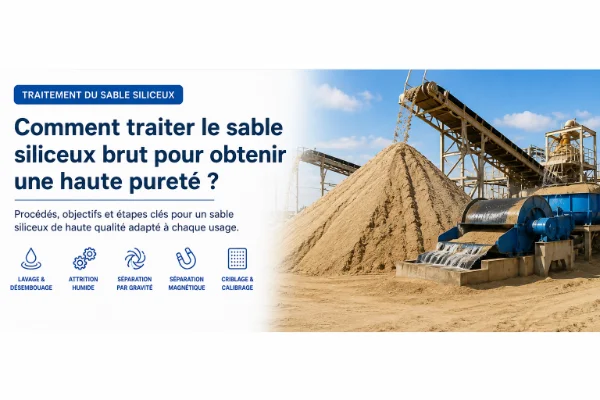
Raw silica sand cannot be used as it is in industry. Before it can be sold, it must undergo a series of treatments designed to increase its SiO₂ content, reduce impurities such as iron oxides, and achieve a precise particle size distribution. Washing, attrition, screening, magnetic separation: each process meets strict requirements depending on the intended application, whether it be glassmaking, foundry work or filtration.
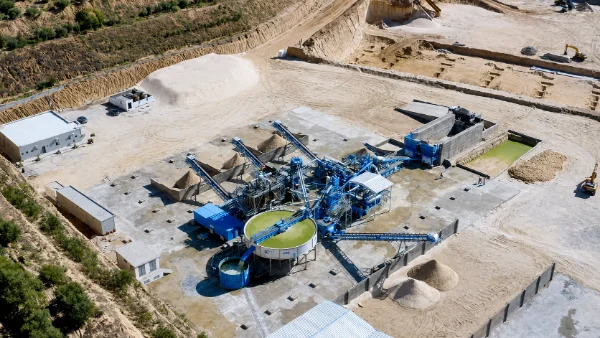
Why process raw silica sand?
Impurities to be removed (Fe₂O₃, clays, oxides)
Raw silica sand is never extracted in its pure form from the deposit. Various impurities cling to the quartz grains and degrade the sand quality before any treatment.
The three main categories of impurities to be targeted are:
- Fe₂O₃ (iron oxide) : turns the glass green or brown, even at a concentration of 0.03 %
- Clays : form a matrix around the grains and disrupt the particle size distribution
- Aluminium and titanium oxides (Al₂O₃, TiO₂) : adversely affect the physical properties of the finished product
These fine impurities cannot be removed simply by rinsing. The purification of silica sand requires a combination of mechanical processes to remove each contaminant bound to the surface of the sand particles.
At Djebel Ouazzan, Silice Santa Cruz uses naturally graded sand as its raw material. This deposit has a high initial SiO₂ content, which reduces the amount of impurities that need to be removed during extraction.
Purity targets according to end use
Each industrial sector sets a specific threshold for silicon dioxide to be achieved. This threshold directly determines the performance of the finished product.
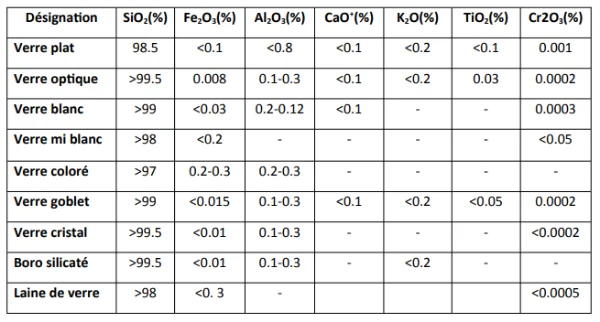
The glass manufacturing requires the highest standard: SiO₂ > 99 %, with the Fe₂O₃ content reduced to an absolute minimum to preserve optical transparency. The foundry accepts a slightly lower threshold, around 98 %, which is sufficient to withstand molten metals at 1,550 °C.
Here are the key points for each application:
- Glassware and flat glass : SiO₂ > 99 %, particle size 0–2 mm
- Ferrous and non-ferrous foundries : SiO₂ > 98 %
- Water and swimming pool filtration : SiO₂ > 96 %, 0.4/0.8 mm grade
- Construction and mineral aggregates : less stringent threshold, priority given to particle size consistency
The high-purity silica Designed for technical ceramics and refractories, it adheres to chemical specifications similar to those for glassware, with an additional thermal requirement regarding firing stability.
How should siliceous sand be treated?
Washing and descaling
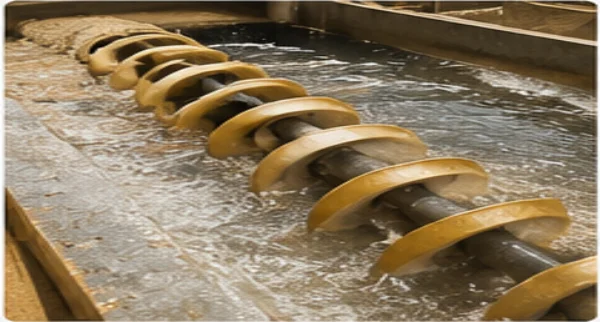
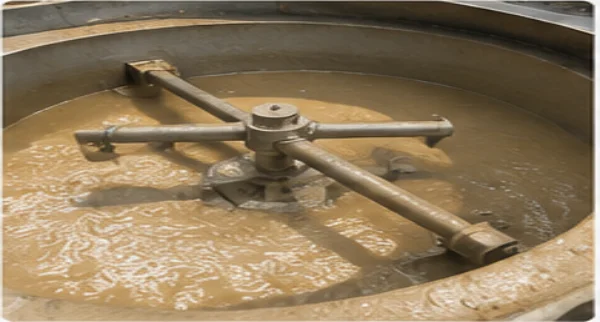
Washing is the first step in any processing of silica sand. A drum washer agitates the grains in water and dislodges the clay particles stuck to the surface. The mechanical action breaks up the aggregates that water alone is unable to dissolve.
Desludging then takes over. This stage removes suspended silt and fine particles using hydrocyclones or dewatering screens. The grain size determines the cut-off settings used.
At Silice Santa Cruz, this process operates without the use of any chemicals. The recycling of wash water reduces the site’s overall water consumption. Each batch processed emerges from the treatment plant graded, clean and in compliance with industry specifications.
Wet attrition
Wet attrition is effective where simple washing fails. The principle is based on the intergranular friction : the grains of sand rub against one another as they are vigorously agitated. This mechanical abrasion strips away the layers of iron oxide and the clay matrix adhering to the surface of the quartz.
In a processing plant, the attrition cells receive the sand in the form of a concentrated slurry. The density of the slurry directly determines the efficiency of mineral processing.
Two concrete outcomes have emerged from this stage:
- Cleaned quartz surfaces residual ferrous deposits
- Reduced Fe₂O₃ content to meet the most stringent glassware standards
For the foundry sand, this stage removes unwanted clays that interfere with metal casting. For Grade A glass sand, it remains essential for reducing the Fe₂O₃ content to below 0.02 %.
Gravity separation
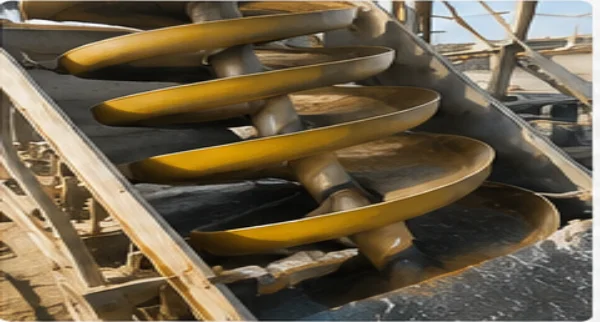
The spiral chute It makes use of a simple law of physics: heavy minerals and silica grains do not have the same density. This difference is sufficient to separate them without the use of any chemical reagents.
The ore flows along the spiral. The dense particles — ilmenite, haematite, iron oxides — move towards the outside of the curve. The lighter quartz grains remain in the centre and form a distinct flow of their own.
The chute has three outlets:
- Siliceous concentrate, which can be put to immediate use
- Intermediate ore, revised in the second round
- Heavy residues, discharged into the settling tank
This process significantly reduces the Fe₂O₃ content, before the magnetic separator does not complete the purification process to meet the most stringent glassware standards.
Magnetic separation
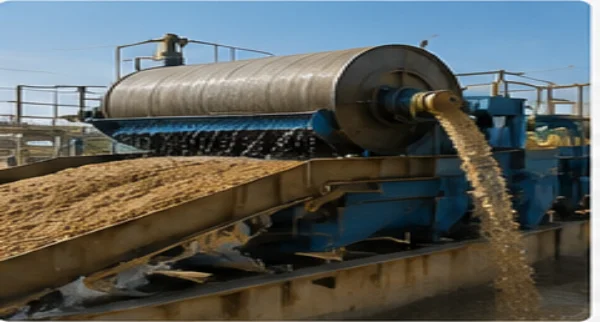
The wet plate magnetic separator targets the ferrous minerals that the spiral does not completely retain. Limonite, haematite and biotite remain trapped in the sand flow after gravity separation.
A magnetic field of around 13,000 Oersted attracts these weakly magnetic particles. Quartz, which is non-magnetic, passes through the equipment without being deflected.
This process makes it possible to achieve a rate of Fe₂O₃ less than 0.02 %, the threshold required by the glass industry. Silice Santa Cruz incorporates this stage directly into its processing line at El Aricha.
The minerals collected include, in particular:
- Limonite and haematite, the most common iron oxides
- Tourmaline and biotite, fine paramagnetic minerals
The moisture content of the pulp has a direct impact on the efficiency of magnetic separation. Precise adjustment of the solids density optimises the equipment’s performance.
Flotation and particle size classification
Flotation takes place after magnetic separation. In flotation cells, air is injected into the suspension of sand pulp. The bubbles rise, carrying residual iron oxides, feldspar and mica to the surface — a foam laden with impurities which is skimmed off mechanically.
The pH and the collecting reagents determine the efficiency of the process. Precise adjustment enables a SiO₂ content of close to 99 % to be achieved for grade A glass sand.
Particle size classification then takes over. Hydrocyclones separate the fractions by size and density. For foundry sand, a cut at 350 µm isolates the active fraction. For filtration, the 0.4–0.8 mm range is the standard. Silices Santa Cruz grades each batch according to the customer’s end use.
What equipment is needed for a treatment plant?
Trommel screens, hydrocyclones and screens
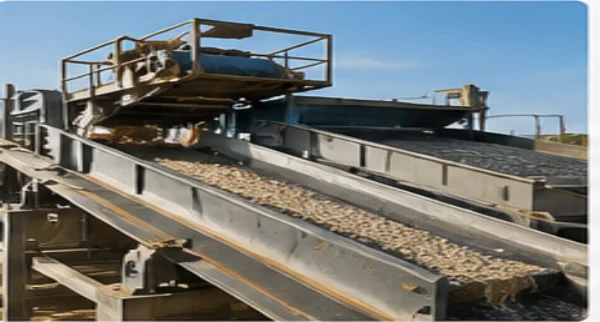
The trommel is the first mechanical filter in the process. This perforated rotating drum operates at a slight angle: particles smaller than 2 mm pass through the mesh, the coarse rejects are channelled from the end of the drum to a ball mill.
This primary screening protects downstream equipment and stabilises the feed flow. Without this stage, the fine screens would quickly become clogged.
The hydrocyclone then takes over the processing of the fine fraction. It generates a centrifugal force that separates the particles according to their density. The slurry rich in Fe₂O₃ is discharged via the overflow, whilst the concentrated siliceous sand flows down towards the spirals.
The fine sieve provides the final size classification prior to separation. A 0.8 mm mesh ensures a consistent and even feed to the subsequent separation equipment, which is a prerequisite for a increase in production without any loss of quality.
Attrition screener and magnetic separator
The attrition scrubber operates in a wet environment. It agitates the sand at a pulp concentration of 65 to 70 %. The intense friction between the grains strips away the clay films and stubborn oxides that conventional washing equipment is unable to remove.
This system uses a closed-loop system to minimise water consumption. The result is less waste and controlled operating costs.
The magnetic separator then takes over. Two types of equipment are used in sequence in the process:
- The drum separator (approx. 4,000 gauss): captures highly magnetic minerals
- The High-Gradient Separator (HGMS) : removes residual weakly magnetic particles
Silices Santa Cruz incorporates both pieces of equipment into its production process at El Aricha. This combination ensures consistent purity, batch after batch.
Process water management and recycling
The wet processing of silica sand consumes a great deal of water. Recycle this process water reduces the strain on natural resources and meets current regulatory requirements.
There are three technical solutions for managing these flows:
- The lagoons : natural storage by gravity sedimentation, suitable for large available areas
- Compact sedimentation tanks : two pools used in rotation, one in use, the other awaiting draining
- AKA-SET clarifiers : rapid water clarification for immediate reuse in washing
Some fine-particle removal systems achieve a recycling rate of 95 % of process water.
The cost of an installation varies depending on the flow rate and the type of clarifier chosen. At Silices Santa Cruz, mechanical water treatment incorporates the recirculation of wash water right from the process design stage, without the addition of chemicals.
What are the uses of treated silica sand?
Processed silica sand is used in a wide variety of sectors. It is one of the most abundant minerals in the Earth’s crust, silica is only of industrial use once it has been purified.
The glass industry remains the world’s leading market. It requires SiO₂ of over 99 % to produce float glass, packaging or optical fibres. The foundry industry accepts a slightly lower threshold — around 98 % — for making moulds capable of holding molten steel.
Other sectors use specific grades:
- Water filtration and swimming pools : particle size 0.4–0.8 mm, service life 3 to 5 years
- Construction : coarse sand, 2–5 mm, for concrete and mortar
- Abrasive blasting : Mohs hardness 7 for stripping metal surfaces
Silices Santa Cruz supplies each grade, graded in accordance with these precise requirements.
Find out more about the industrial and domestic uses of silica sand, on an app-by-app basis.
Find out more about the uses of silica sand
Chemical-free sand treatment: the Silices Santa Cruz approach
A 100 % mechanical and hydraulic process
Silice Santa Cruz processes its silica sand without the use of acid, flotation reagents or surface additives. The process relies solely on water and mechanical action: drum washing, desliming using hydrocyclones, wet attrition, gravity separation using spiral separators, followed by magnetic separation.
This choice stems directly from the quality of the deposit. The sand extracted at Djebel Ouazzan, in the wilaya of Tlemcen, has a natural SiO₂ content of over 98 % straight from the quarry. Whereas low-grade ore requires costly acid leaching to meet industrial specifications, a naturally pure deposit requires only physical purification.
Response within 24 hours · Free quote
A need for siliceous sand?
Get a detailed quote for your high-purity silica sand (SiO2 > 98 %) sourced from the Djebel Ouazzan deposit. Technical advice, bespoke particle size grading and logistics tailored to your volumes.
- Particle size distribution calibrated to order
- Batch Analysis Report
- Mechanical treatment without chemicals