
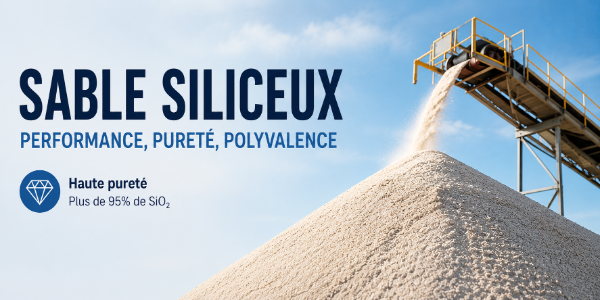
Siliceous sand is a natural material consisting mainly of silicon dioxide (SiO₂), extracted from quartz rock. Its hardness, high purity and chemical stability make it a sought-after material in many professional sectors.
What is silica sand?
Siliceous sand is a natural mineral. It consists mainly of silicon dioxide (SiO₂), formed by the weathering of quartz. To qualify for this designation, sand must contain at least 95 % of SiO₂.
Its high purity gives it remarkable chemical inertness. It does not react with its surroundings. This stability explains its role in applications as varied as:
- Filtration : swimming pool filtration systems and wastewater treatment
- Construction : concrete, mortar, industrial moulding
- The glass industry : raw material accounting for 70 % of the glass composition
Its particle size varies depending on the treatment applied after extraction. Each grade meets specific technical requirements.
Particle sizes: fine, 0/4, 0.4/0.8 mm and extra-siliceous
At Silices Santa Cruz, each particle size is designed for a specific application. The choice of grain size directly determines the material’s performance.
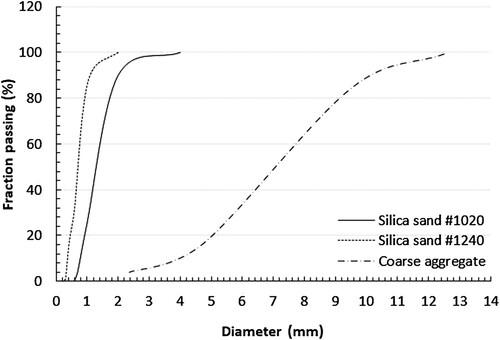
Here are the four ranges available and their applications:
- Fine sand : ideal for finishing plasters, epoxy resins and non-slip coatings
- 0/4 mm : suitable for mortar, lightweight concrete and general masonry work
- 0.4/0.8 mm : the leading name in swimming pool filtration, wastewater treatment and sports facilities
- High in silica : SiO₂ purity greater than 99 %, intended for use in glassmaking and demanding industrial applications
The 0.4/0.8 mm particle size offers an extended service life in filtration applications. Its particles are more resistant to wear than finer grades.
All these products are available in home delivery, in bags or in bulk, depending on the quantities ordered.
Need a siliceous sand high quality?
Contact our experts to get a proposal tailored to your business and receive your personalised quote as soon as possible.
REQUEST YOUR PERSONALISED QUOTE →- ✔ Free, no-obligation quote
- 🕒 Response within 24 hours
- 💧 SiO2 > 98 %
Which type of silica sand is best suited to which application?
Natural grass and artificial turf
Siliceous sand serves different purposes depending on the type of turf. Two distinct uses, two different approaches.
On natural grass, 0/4 mm washed silica sand improves soil drainage. It loosens compacted clay soils and promotes grass root growth.
For details on application rates per square metre, prices and the choice between rolled and crushed gravel, see our guide to lawn sand
On artificial turf, it acts as a weighting material. Distributed amongst the fibres, it fulfils three key functions:
- Stability : it anchors the turf to the ground and eliminates creases
- Fibre retention : it straightens the strands and gives them a natural look
- Thermal protection : it lowers the surface temperature of the grass in direct sunlight
The recommended particle size is between 0.4 and 0.8 mm. Allow 5 to 20 kg per m² depending on the height of the blades. Washed, dried and dust-free sand ensures a uniform result without clumping.
Swimming pool filtration and water treatment
For swimming pool filtration, 0.4/0.8 mm washed silica sand is the standard filtration medium. Its SiO₂ purity exceeds 96 %. It retains particles down to 30–40 microns and is resistant to water treatment chemicals.
Its service life is up to 3 to 5 years under normal conditions. Regular backwashing restores its filtering capacity without damaging it.
The requirements for on-site sewage treatment (ANC) are changing. The sand required is a 0/4 mm, compliant with standard NFU 44-001, with a uniformity coefficient of between 2 and 4. The filter layer must be at least 70 cm thick, in accordance with DTU 64.1.
At Silices Santa Cruz, our sands are suitable for both of these applications:
- Swimming pool filtration : washed sand 0.4/0.8 mm, low fines content
- Domestic sewage treatment : 0/4 mm sand, limestone content less than 20 %
Sandblasting, painting, aquariums and paving joints
Silica sand also has four further, often little-known uses.
Firstly, when it comes to sandblasting, the quartz grains effectively strip metal, wood and plastic. They therefore remove rust, old paint and stubborn dirt without damaging the surface.
Next, when it comes to paint, silica sand serves a different purpose. Indeed, when added to industrial and exterior paints, it helps to create a textured, non-slip finish.
Furthermore, it is the most commonly used substrate for aquariums. As it is composed of pure SiO₂, it does not affect either the pH or the water hardness. What’s more, its fine grains ensure excellent visual clarity in the tank.
Finally, in cobbled surfaces, silica sand fills the joints between the cobblestones. This absorbs any movement caused by changes in weather conditions and helps to maintain the stability of the surface over time.
Find out more about the uses of silica sandWhat is the difference between silica sand and ordinary sand?
The boundary is clear. Sand is described as siliceous if it contains at least 95 % of SiO₂ and less than 0.6 % of iron oxide. Below this threshold, it is referred to as ordinary sand.
Ordinary sand, also known as feldspathic sand, can contain up to 80 % of SiO₂. The rest? Iron, carbonates, potassium and clays.
These impurities make all the difference:
- Chemical reactivity : ordinary sand reacts with certain binders and chemicals
- Colour : iron oxides give it brown or orange hues
- Particle size distribution : its grains are irregular and less uniform in size
Siliceous sand, on the other hand, remains inert. Its chemical stability makes it indispensable for filtration, glassmaking and artificial turf. Ordinary sand is suitable for non-technical uses: backfill, general masonry and basic mortar.
Prices, packaging options and ordering by the bag or in bulk
The price of silica sand varies depending on the particle size and the volume ordered. For bulk orders, allow for between €20 and €50 per tonne (excluding VAT) for standard particle sizes. For high-purity industrial grades (SiO₂ > 98 %), the price range is between €60 and €120 per tonne, excluding VAT.
At Santa Cruz Silica, there are several packaging options to meet professional needs:
- 25 kg bag : ideal for small-scale projects or particle size analysis
- One-tonne big bag : suitable for medium-sized quantities, easy to store
- Bulk goods in a skip : the most cost-effective solution for large quantities
The unit price falls significantly once an order of one tonne or more is placed. Request a personalised quote Contact Silices Santa Cruz directly to obtain a quote tailored to your order volume and particle size.