
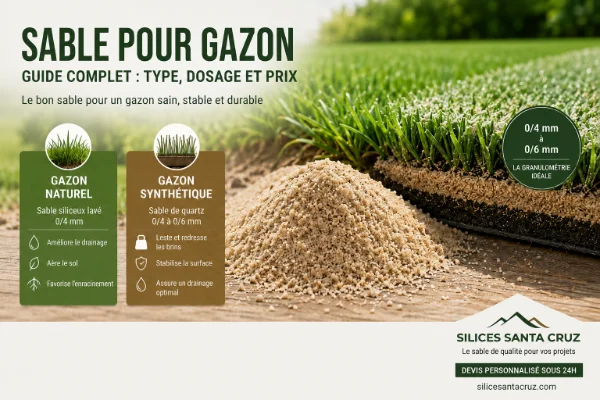
Where to buy lawn sand. Sand improves drainage, loosens the soil and stabilises the grass blades. But not all sands are the same. For long-lasting results, choose a washed silica sand with a particle size between 0.4 and 0.8 mm. The amount required varies from 5 to 20 kg per m² depending on the height of the blades. In this guide, you will find the right type of sand, the correct amount required and current prices.
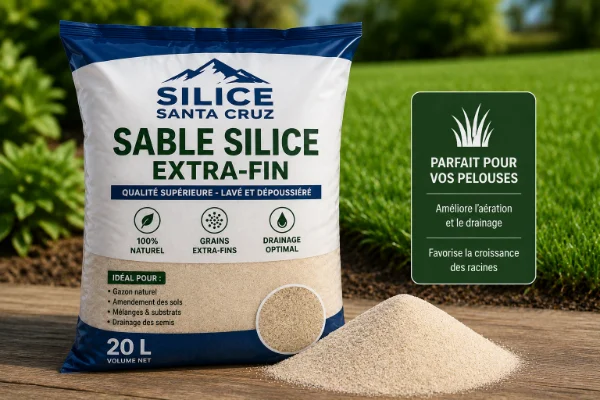
What type of sand should you choose for natural or artificial grass?
The choice of sand depends first and foremost on the type of lawn. Two uses, two different approaches.
- For natural grass : Washed silica sand (0–4 mm) is ideal. It improves drainage without compacting the soil. The roots can breathe and water drains away freely.
- For artificial turf : 0/4 to 0/6 mm quartz sand is essential. It weighs down the blades of grass, straightens them and stabilises the surface. Crushed sand compacts better than rounded sand.
Sand that is too fine, such as 0/2, may clog the pores in the soil. Conversely, sand that is too coarse leaves visible bumps beneath the lawn.
The rule to remember : the more the turf is used, the more precise the grain size must be and the cleaner the sand must be.
Washed, rounded sand, 0/2 to 0/4, for natural grass
The calibre 0/4 mm is the benchmark for natural grass. Its rolled grains blend into the soil without blocking it. Water passes through the layer and reaches the deeper layers without pooling.
The 0/2, on the other hand, serves a different purpose. It is mainly used for the spring surface sandblasting : Approximately 8 kg per m², spread using a broom after scarification. Result: the soil becomes lighter, giving the roots more space.
Here’s how to tell the two uses apart:
- 0/4 sand : a 3–5 cm layer to improve the structure of clay soil before sowing
- Sand 0/2 : light surface sanding on existing lawn, to aerate without burying the sand
On very compacted ground, combine 0/4 with a drainage geotextile for a long-lasting result.
0/4 to 0/6 quartz sand for artificial turf
0/6 quartz sand copes better with uneven ground than 0/4. On clayey or undulating ground, it is this grade that provides the structural base.
Its rounded grains are resistant to crushing and allow water to drain away even under heavy foot traffic. The result: no puddles, no surface deformation.
Another advantage that is often overlooked: quartz regulates the temperature. On a south-facing terrace in summer, it reduces the heat felt underfoot.
Allow between 5 and 15 kg per m² depending on the length of the fibres. Washed, dried and dust-free sand ensures even distribution without forming clumps beneath the flooring.
For high-traffic areas — school playgrounds, sports pitches, communal spaces — 0/6 remains the most durable grain size.
Prices, quantities and where to buy your lawn sand
The price of sand for lawns varies depending on the packaging and the distance from the quarry. In bulk, Crushed sand (0/4 or 0/6) costs between €30 and €70 per tonne, excluding delivery. For a one-tonne big bag, expect to pay between €58 and €90 (including VAT), depending on your region.
When it comes to measuring out quantities, bear in mind these simple guidelines:
- Natural grass : 4 to 6 litres per m², or approximately 4 kg/m²
- Artificial turf : 5 to 20 kg per m² depending on the height of the strands
To buy sand for lawns, contact your nearest quarry directly. This is the cheapest option. For large quantities — sports pitches, communal areas or projects in Algeria, France or the Middle East — Silices Santa Cruz provides a personalised quote within 24 hours, available in bulk or in big bags to suit your site.