
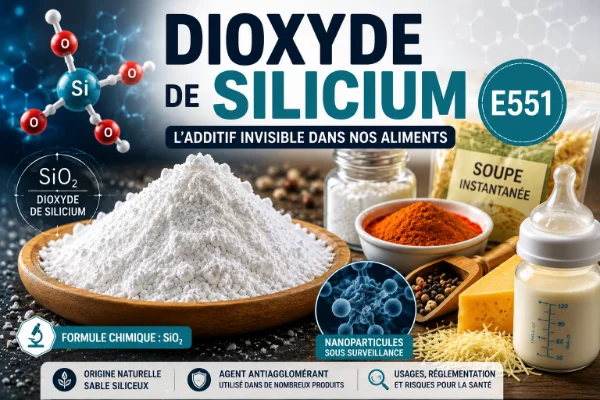
Silicon dioxide, or E551, is an anti-caking agent extracted from quartz sand. It is found in spices, packet soups, grated cheese and infant formula. Its nanoparticle form raises serious health concerns. ANSES and INRAE are urging caution regarding its long-term effects. This article examines its uses, regulatory framework and actual risks.
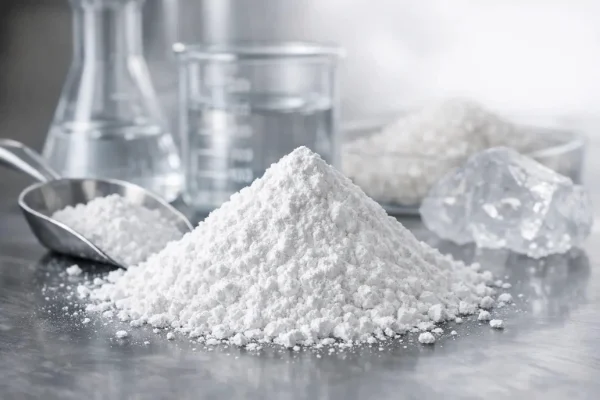
Silica (SiO₂): chemical formula and physical properties
Silicon dioxide is generally produced from natural raw materials such as siliceous sand. He associates one silicon atom and two oxygen atoms. Its molar mass is 60.084 g/mol. This compound accounts for more than 60 % of the mass of the continental crust.
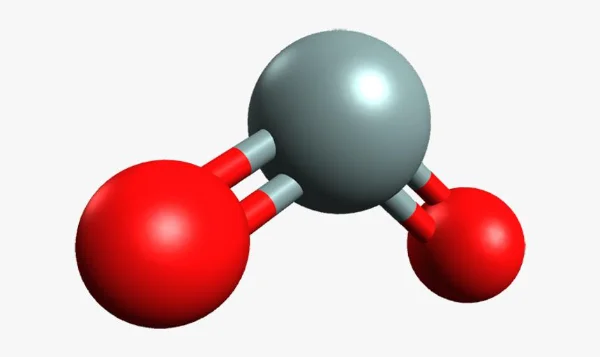
Its crystal structure is based on tetrahedra, in which each silicon atom bonds with two oxygen atoms. This is what gives it its remarkable stability.
Its key physical properties:
- Melting point : 1,713 °C — exceptional heat resistance
- Hardness : 7 on the Mohs scale
- Solubility : insoluble in water at room temperature
- Chemical inertness : resistant to most acids, except hydrofluoric acid
In the form of rock dust or sand derived from the’sand and quartz extraction, SiO₂ comes in crystalline and amorphous forms, each with distinct properties.
Is silicon dioxide the same as sand?
No, but it’s derived from it. The siliceous sand consists mainly of silicon dioxide, but in its natural crystalline form, which is different from that used as a food additive.
Silicon dioxide (E551) in food: its role and the products it is found in
The E551 fulfils a specific role in the food and drink industry: to prevent powders from clumping. Without it, spice mixes, instant soups and salt substitutes would form lumps.
It can be found in a surprising range of everyday products:
- Powdered foods : soups, instant coffee, baby cereals
- Sliced cheese : to prevent sticking
- Chewing gum : as a texturising agent
- Spices and flavourings : to keep things moving smoothly
The acceptable daily intake has not been formally established by EFSA, due to a lack of sufficient data on nanoscale aggregates. Researchers at INRAE have also established a link between exposure to this additive and a reduction in tolerance to dietary proteins, raising the question of a link with coeliac disease.
Is silicon dioxide dangerous?
Amorphous nanoparticles: risks and uncertainties
Synthetic amorphous silica nanoparticles measure between 2 and 28 nm. At this scale, the particles smaller than 100 nm behave differently from conventional silica.
However, studies carried out on animal models point to some worrying effects: oxidative stress, impaired cell division and liver damage. Researchers have also observed disruption to the gut immune system in rodents exposed to doses equivalent to those given to humans.
The real difficulty for humans remains the uncertainty involved in assessment: we do not know precisely what proportion of these aggregates retains a nanometre-scale size after ingestion. It is precisely this security issue which has prompted ANSES to call for stricter regulatory controls on all food-grade nanomaterials.
What the EFSA and ANSES say in 2026
In October 2024, EFSA published its Final conclusions on E551. His verdict: no security issues identified for all population groups, including infants under 16 weeks of age, at the reported levels of use.
However, the European agency has decided not to set a maximum permissible daily intake. There is still insufficient data to quantify precisely the proportion of free nanomaterials in food.
For its part, ANSES applies the precautionary principle since 2020. It acknowledges that E551 is present, at least in part, in nanoscale form in certain processed products. Several in vitro studies suggest that it has a stress-inducing effect on intestinal cells.
The two agencies agree on one point: further industry data is still needed to resolve these uncertainties.
Practical advice: read the labels and limit your exposure
On a label, look for the code E551 or the words «silicon dioxide» in the list of ingredients. This is the most reliable indicator.
Please note that, in the case of spirits, there is no legal obligation to include this labelling. However, European Regulation No 1169/2011 requires nanomaterials to be labelled with the term «[nano]» — but some manufacturers circumvent this rule as soon as the silicon dioxide absorbs water and swells.
To effectively reduce your exposure, here are some habits to adopt:
- Opt for unprocessed products rather than processed powdered mixes
- Always check sliced cheese, spices and chewing gum
- Contact the manufacturer if the label is vague about the form used
A diet consisting of less processed foods remains the most straightforward way to limit daily intake of anti-caking additives.